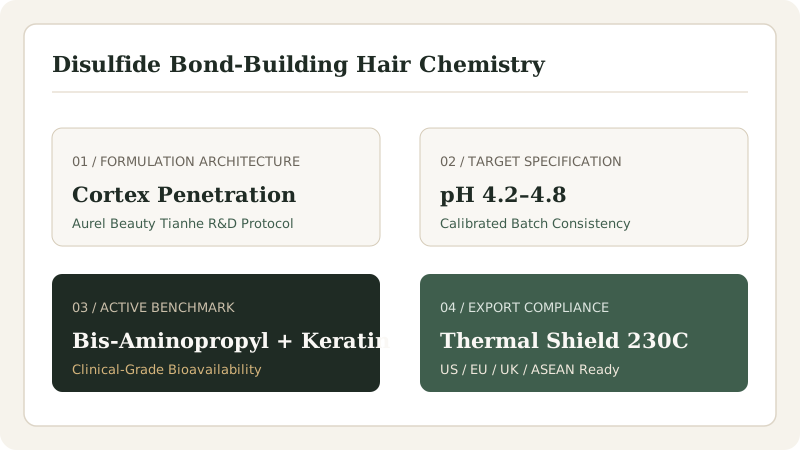
Disulfide Bond Repair Chemistry in Private Label Hair Care
How maleic amino polymers and low-dalton keratin peptides reconnect broken disulfide linkages inside bleached hair cortexes.
Peer-reviewed chemistry briefs, FDA MoCRA and EU CPSR roadmaps, surfactant engineering notes, and B2B launch economics authored by our Tianhe Guangzhou laboratory leads.
How maleic amino polymers and low-dalton keratin peptides reconnect broken disulfide linkages inside bleached hair cortexes.

Balancing Sodium Cocoyl Isethionate, Cocamidopropyl Betaine, and Decyl Glucoside to achieve luxury foam at pH 5.2 without scalp irritation.

Comparing dosing thresholds, pH compatibility, and EDTA chelating pitfalls when formulating drug-free scalp density tonics.
Why global private label brands migrated to Piroctone Olamine after the EU Annex II ban on ZPT, plus chelation best practices.
How to market botanical scalp oils and density serums on Amazon and DTC without triggering FDA drug misbranding warnings.
EU cyclic silicone restrictions and sensory formulation strategies for weightless, non-buildup hair shine oils and heat sprays.
Preventing hygral fatigue and frizz in humid climates by pairing D-panthenol and trehalose/tremella with hydrophobic esters.
Removing calcium, magnesium, and copper ions from hair fibers using biodegradable sodium phytate and tetrasodium glutamate diacetate.
Calibrating hydrolyzed rice protein molecular weight and cationic conditioning ratios to avoid brittle stiffness on low-porosity hair.
Stabilizing Elaeis oleifera butter against graininess and oxidation in viral hair masks and rosemary scalp pre-wash oils.
Isoelectric point chemistry of human keratin and how acidic conditioners lock oxidative dye pigments inside the cortex.
Comparing chemical keratinolytics against salt/charcoal physical scrubs for head-spa menus and retail dandruff lines.
Commercial SKU architecture for trending trichology head-spa studios: oil pre-cleanse, acid detox, amino foam, steam mask, and peptide tonic.
Why 2-minute wash contact requires higher caffeine solubility and co-solvent pairing compared to leave-on follicle drops.
Achieving luxury wet-comb slip without heavy polyquaternium buildup or EU-restricted tallow quats.
Evaluating film-forming quinoa peptides and volatile alkanes under flat-iron and blow-dryer stress testing.
Preventing pigment settling, bottle staining, and green-cast shifts in blonde maintenance shampoos and masks.
Replacing rigid PVP/carbomer crunch with flexible botanical mucilage for Type 3 and Type 4 curls.
Sub-150nm callus extracellular vesicles paired with GHK-Cu and madecassoside for medspa hair restoration.
Supporting commensal scalp flora without harsh antifungal stripping in daily sensitive-skin shampoos.
Why B2B beauty brands are replacing butane aerosol cans with rice starch puff powders and niacinamide scalp mists.
Standardized fatty-acid phytosterol extracts paired with zinc PCA and caffeine for male scalp thickness positioning.
Navigating FDA/EU scrutiny on isopropyl cloprostenate by formulating safe Biotinoyl Tripeptide-1 lash enhancers.
Balancing tea tree, jojoba wax esters, and bisabolol to relieve tension itch without heavy petrolatum residue.
Blocking copper-induced green discoloration and cuticle swelling for swim and resort hair lines.
Fast-breaking lamellar emulsions and dry esters that absorb within 60 seconds without staining linen.
Harnessing fermented bull kelp polysaccharides for natural wet-detangling slip and scalp hydration.
Integrating standardized Rb1/Rg3 botanical extracts into contemporary sulfate-free density routines.
Achieving coacervate conditioning release during water rinse-off without heavy buildup on fine hair.
Salt-free polymer thickening alternatives (xanthan, PEG-120 dioleate) preserving expensive salon smoothing bonds.
Eliminating under-beard acne and beardruff with non-comedogenic dry esters and IFRA woody-amber oils.
Tuning emulsion waxes and silica powders for zero-grease reworkable hold that washes out cleanly.
Keeping protein-bond and tape-in extensions secure by managing alcohol, oil polarity, and silicone weight.
Quenching singlet oxygen radicals that bleach copper and pastel salon hair dyes in summer sunlight.
Comparing oxidation kinetics, pH stinging thresholds, and airless vs. amber packaging ROI for private label Vitamin C serums.
Selecting the right collagen-boosting pathway for sensitive, pregnancy-safe, and clinical medspa consumer segments.
Why simply sprinkling 0.01% ceramide powder fails—and how high-shear liquid-crystal emulsions rebuild stratum corneum mortar.
Combining four molecular weights of HA with natto-fermented PGA for non-pilling surface bounce and deeper moisture retention.
Raw material purity thresholds, citric acid pH buffering above 5.0, and zinc PCA compatibility rules.
Formulating hydroquinone-free spot correctors while maintaining pH 5.2–5.8 to stop arbutin hydrolysis.
Molecular size penetration curves explaining why PHAs exfoliate rosacea-prone skin cleanly without barrier stinging.
Solving the notorious grittiness and high-solvent crystallization of pure azelaic acid in private label formulations.
How halophilic amino derivatives structure hydration shells around proteins against UV and surfactant stress.
Replicating signature stringy mucin bounce using botanical glycoproteins for cruelty-free global retail.
Pairing matrikine collagen signalers with SNARE-modulating hexapeptides for visible line-smoothing products.
Pre-dissolving phenolic tyrosinase inhibitors with ethyl vitamin C and squalane for long-term emulsion clarity.
Why standardized triterpene isolates outperform generic leaf water in clinical redness-relief recovery lines.
Consistent batch purity, odorlessness, and RSPO/sustainability traceability for global skincare exports.
Using polyglyceryl-4 oleate and candelilla/shea matrices to melt waterproof mineral SPF cleanly.
Preventing barrier lipid disruption and rebound oiliness by replacing soap/SLS bases with taurates and isethionates.
Balancing low-pH AHA keratolytics with ceramides and colloidal oat to prevent stinging on shaved legs.
Managing 45-micron particle sieve specs and antifungal PET testing in oat-rich sensitive skin formulas.
Blending shea esters, squalane, and ceramide NP to mimic cushiony high-shine balm textures trending on TikTok Shop.
Delivering velvety soft-focus makeup grip without dimethicone pilling over water-based serums.
Recycling oxidized vitamin E radicals overnight with ubiquinone and rosehip omega fatty acids.
Using tremella and hydroxyethylcellulose networks so 25ml of serum clings cleanly without dripping.
Eliminating carbomer breakdown under high saline/mineral load in esthetician treatment rooms.
Addressing both vascular redness and pigment transfer in non-comedogenic acne recovery gels.
Controlling axillary odor at pH 5.2 without the alkaline pH 9 rash caused by sodium bicarbonate.
Achieving uniform streak-free pigment suspension across 6–12 inclusive shades with zero chalkiness.
Chelation, pH buffering, and UV bottle specs that keep catechin formulas fresh and pale sage.
Preventing trace hydroquinone formation during 45C accelerated aging with proper citrate buffering.
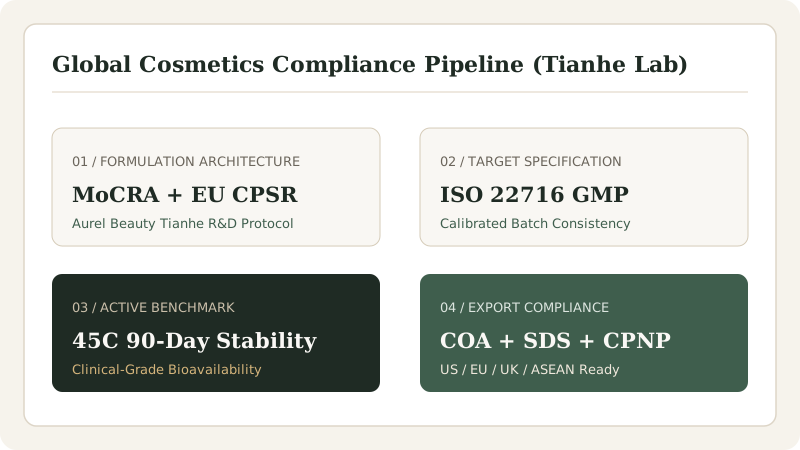
Understanding facility FEI alignment, cosmetic product listings, safety substantiation, and adverse event labeling under MoCRA.
What documents your Guangzhou manufacturer supplies for Part A/B safety assessments, CPNP, and UK SCPN notification.

Water purification loops, cleanroom zoning, lot traceability, and batch retention samples every buyer should verify.
Why 90-day thermal stability and 28-day microbial challenge tests prevent swollen bottles and mold recalls.
ROI breakdown for multi-chair salons switching from branded 250ml retail bottles to private label 1L and 5L backbar refills.
Unit cost, label printing, DHL air vs. ocean DDP freight, and landed retail margin modeling for new DTC founders.

Matching oxygen-sensitive peptides, essential oils, and acidic toners to chemical-resistant resin and glass grades.
How post-consumer recycled bottles cut air-freight carbon and shipping bills compared to heavy flint glass.
Exact invoice, COA, induction seal, and FNSKU carton labeling specs required for smooth Amazon FBA receiving.
Split-shipment air/sea logistics and pre-retained bulk vat strategies for unpredictable social commerce spikes.
Navigating essential oil phototoxicity, limonene/linalool disclosure thresholds, and allergen-free parfum options.
How 300ml tamper-proof wall mounts paired with 5L refill casks cut plastic waste and housekeeping labor.
Decision matrix comparing launch speed, 500-vs-3000 MOQ, R&D stability costs, and formula differentiation.
Comparing active-ingredient agility, packaging tooling turnaround, MOQ flexibility, and landed DDP unit cost.
Replacing 'treats alopecia/eczema' drug triggers with compliant appearance-based hair density and soothing language.
Preservative reserve calculation, clean vat sanitization, and essential oil blending steps for regional brand fillers.
Torque calibration, PE-foam vs. heat-induction foil seals, and ISTA-3A drop testing for e-commerce bottles.
Correct US FDA and EU INCI naming conventions, botanical Latin binomials, and colorant CI numbers.
Using organic acid esters, pentylene glycol, and caprylyl glycol boosters at pH < 5.5 for broad-spectrum defense.
A 7-point lab bench checklist covering flash foam, wet-detangle force, dry residue, scent fade, and cold-stability.
Alcohol-free halal-minded formulation choices, SFDA/GSO documentation, and high-heat 45C transit stability.
Barrier laminate specs (PET/AL/PE vs. mono-PE) for liquid shampoos, hand washes, and salon backbar refills.
Selecting high-repeat anchor SKUs: thickening shampoo, matte clay, beard oil, 2-in-1 wash, and cooling scalp tonic.
Pairing Copper Tripeptide, THD Vitamin C, and post-laser cica gels in clinical airless packaging.
Why co-washes, shea-batana masques, non-flaking phytomucin gels, and edge oils drive highest repeat LTV.
Selecting emulsified sugar scrubs, arnica recovery gels, and non-staining jojoba massage oils for spas.
Pairing salon cabin aloe-chamomile calming gels with take-home 10% glycolic ingrown-hair roll-ons.
Auditing preservatives, ethoxylated surfactants, and cyclic silicones before locking retail packaging.
Balancing cash-flow lead times between 7-day DHL air launches and 28-day DDP sea replenishment.
Avoiding ethanol-heavy aerosol restrictions with water-based hair mists and high-flash-point oils.
Substituting sheep-wool keratin and bovine collagen with fermented rice, quinoa, and sh-polypeptide-121.
Blocking 290–450nm UV wavelengths that degrade essential oils, bakuchiol, and L-ascorbic acid.
Packaging architecture and filling economics for travel sizes, trial funnels, and beauty subscription boxes.
Why launching with 3 complementary hero SKUs outperforms bloated 15-SKU catalogs for first-year cash efficiency.